MIDI Programs
MIDI File Player (External Device)
MIDI Destination Pop-Up Button
Other Programs
Cocoa Sample Programs
Syntax Coloring Using Flex
Algorithms
Jazz Chord Analysis as Optimization
A blog where I will write mostly about programming in Cocoa and CoreMIDI, and experiences from my ports of Emacs and XEmacs to the Mac OS.
| Section Marks |
Wrote some code to display section marks extracted from BiaB files. I’ll work on editing them and storing them in my own text format tomorrow. I’ll also need to work on generating variations in the accompaniment when a song changes sections. It shouldn’t be hard to put drum fills at the end of the sections, and, say, to switch the ride cymbal to hi-hat. More involved variations will require more design work. It is important to represent and make use of section information in tunes because this is what gives accompaniments generated by BiaB a little life (if one can call it that).
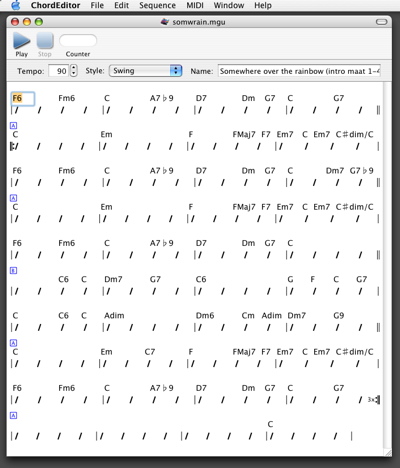
| Graphic Representation of Chorus Parameters |
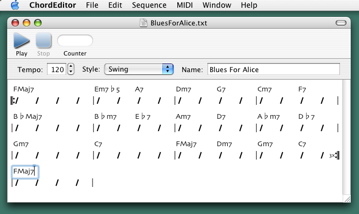
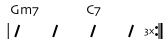
A chorus is specified by its beginning and ending bars, and the number of times it’s repeated. A simple application for practicing improvisation (like BiaB or MiBAC Jazz) supports only one chorus per song. I wrote some code today for displaying and editing this information in my chord editor.
| Choruses And Sections |
Worked on some code to extract the beginning and ending bars of the chorus of a song in BiaB format. I also figured out how to determine the bars at which each section begins. Because there are a newer and an older BiaB format, I needed to repeat this detective work for both of them. Here’s a screenshot of one of the demo songs in the BiaB demo.
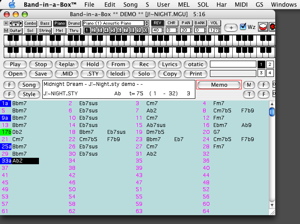
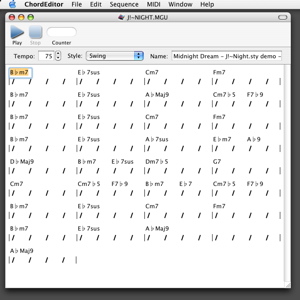
2004-10-06 22:58:15.836 ChordEditor[1156] Section A: bar 1
2004-10-06 22:58:15.858 ChordEditor[1156] Section A: bar 9
2004-10-06 22:58:15.871 ChordEditor[1156] Section B: bar 17
2004-10-06 22:58:15.872 ChordEditor[1156] Section A: bar 25
2004-10-06 22:58:15.872 ChordEditor[1156] Section A: bar 33
2004-10-06 22:58:15.873 ChordEditor[1156] Chorus begin = 1
2004-10-06 22:58:15.873 ChordEditor[1156] Chorus end = 32
2004-10-06 22:58:15.873 ChordEditor[1156] Repeats = 3
| Orange Ice Cream!! |
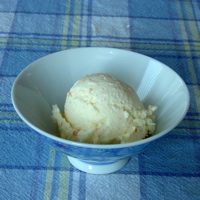
Oranges are sweet and juicy this time of year, so I was thinking about making orange ice cream all weekend. I found a recipe on the Epicurious web site and another one at the Joy of Baking web site. I didn’t like the idea of heating orange juice so I following the recommendation in my trusty Joy of Cooking cookbook and added the orange juice (cold) after the cream has been churned for five minutes. Here’re my ingredients, which is a combination of the above recipes: 1.5 cups whipping cream, 0.5 cup whole milk, 2 egg yolks. 0.5 cup sugar, 1 tsp. vanilla extract, juice and zest of two big naval oranges. Optionally add 1 tsp. orange extract.
On a completely different topic, my current favorite program on public TV is Norm Abram’s New Yankee Workshop.
| Drum Note Numbers and Volumes |
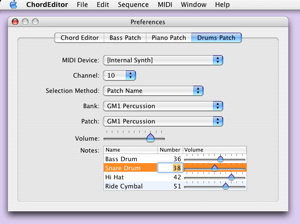
Well, some programming tasks are more interesting than others. Today I just worked on finishing the preferences panel and the use of user default values in the rest of the program. This turns out to be a bit of work because part of my program is in Objective C and the rest in C++. The same trick I’ve been using still works: passing CoreFoundation/Cocoa collections as parameters. Unmarshelling these parameters using CoreFoundation functions requires more code than doing the same thing in Cocoa though.
Anyway here’s a picture of the Drums Patch tab view item, which contains a table for specifying MIDI note numbers and individual volumes for the drum set.
| Sun | Mon | Tue | Wed | Thu | Fri | Sat | |
| 1 | 2 | • | |||||
| 3 | 4 | 5 | 6 | 7 | 8 | 9 | ← |
| 10 | 11 | 12 | 13 | 14 | 15 | 16 | • |
| 17 | 18 | 19 | 20 | 21 | 22 | 23 | • |
| 24 | 25 | 26 | 27 | 28 | 29 | 30 | • |
| 31 | • | ||||||
| Sep Nov |


Lists
Less-Known Facts About Emacs
Chinese Restaurants in Calgary
Calgary/Banff Tourist Attractions
Top-10 Reason I Stopped Working on Emacs
Misc