MIDI Programs
MIDI File Player (External Device)
MIDI Destination Pop-Up Button
Other Programs
Cocoa Sample Programs
Syntax Coloring Using Flex
Algorithms
Jazz Chord Analysis as Optimization
A blog where I will write mostly about programming in Cocoa and CoreMIDI, and experiences from my ports of Emacs and XEmacs to the Mac OS.
| Text Completion for Chords |
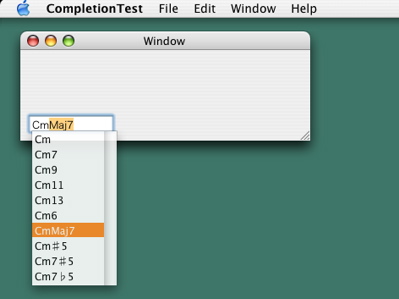
The Cocoa API in Panther added a new “text completion” feature for text views (using the F5 function key or option-Esc). Since the field editor that handles text editing for text fields is also a NSTextView, text completion can also be provided for text fields. By default the suggestion list is obtained by matching the current prefix with the system dictionary. Providing one’s own list of completions efficiently requires subclassing NSTextView and implementing a NSWindow delegate.
Here’s a screen shot of my text completion code for chords in action! I’ll integrate this into my chord editor in the next few days. Unfortunately the Cocoa implementation isn’t perfect at this time: part of the suggestion list pop-up box can go off the screen if the text field appears in a lower part of the screen. C’mon Apple...
| Chord Editor Prototype |
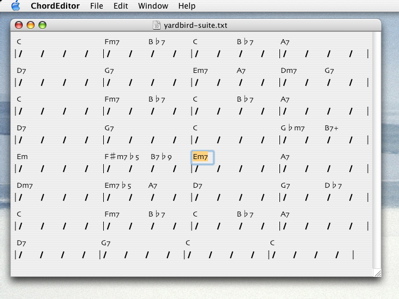
I now believe that the “chord spacing” algorithm I posted on Monday is more important in producing nice looking chord charts than the “optimal bar layout” algorithm I wrote about last week. Since each line may only contain a few bars, there isn’t a lot of flexibility in placing more or fewer of them. This is similar to typesetting with very narrow lines. On the other hand, chords that don’t lined up at their beats give a sloppy appearance.
Here’s an example of the output produced by the chord spacing algorithm. It’s implementation is somewhat tricky :-)! Layout is simply done by fitting as many bars as will fit on a line.
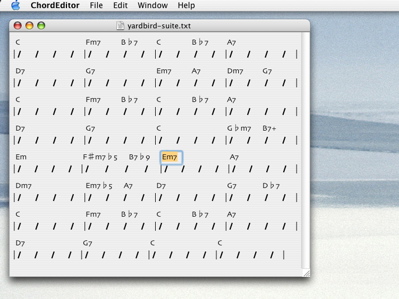
Here’s the same example again with a narrower minimum bar width.
| Chord Spacing |
I’ll let my LaTeX file speak for itself. It’s hard to write about things like this in HTML.
| Sun | Mon | Tue | Wed | Thu | Fri | Sat | |
| 1 | 2 | 3 | • | ||||
| 4 | 5 | 6 | 7 | 8 | 9 | 10 | • |
| 11 | 12 | 13 | 14 | 15 | 16 | 17 | • |
| 18 | 19 | 20 | 21 | 22 | 23 | 24 | ← |
| 25 | 26 | 27 | 28 | 29 | 30 | • | |
| Mar May |


Lists
Less-Known Facts About Emacs
Chinese Restaurants in Calgary
Calgary/Banff Tourist Attractions
Top-10 Reason I Stopped Working on Emacs
Misc