MIDI Programs
MIDI File Player (External Device)
MIDI Destination Pop-Up Button
Other Programs
Cocoa Sample Programs
Syntax Coloring Using Flex
Algorithms
Jazz Chord Analysis as Optimization
A blog where I will write mostly about programming in Cocoa and CoreMIDI, and experiences from my ports of Emacs and XEmacs to the Mac OS.
| A Computational Model for Comping |
I wasn’t able to find a concrete set of rules for comping that can be readily implemented by a computer program. So I needed to devise one on my own. When I was taught to comp on the guitar, I was basically shown a few patterns and then asked to “mix it up and improvise”.
Syncopation plays an important role in comping. More specifically, anticipating a chord an eighth note (triplet) before it starts “pushes” the tune along and breaks up the monotony. But when should we introduce an anticipation? We should neither do it too often nor too seldomly. A good candidate for anticipation is a chord that has the same root as the one preceeding it (this brings rhythmic interest where the harmony is stable) and the V (or I) chord in a ii-V (V-I) sequence (we’re anticipating that chord anyway!). Of course even when one of these criteria is satisfied, we may randomly choose to employ anticipation or not.
The other consideration for generating good comping seems to be the “amount” of syncopation in any given section of the tune. Playing on the beat produces stability while playing off the beat produces syncopation. Too much of either makes the accompaniment unbalanced. A good variety patterns and randomization seem to take care of this quite well.
Here then is an example of an accompaniment for Blues for Alice generated using to the above “rules”. Humanization (varying timing and dynamics) has not been implemented yet, and chord voicings and the drum track are unfinished. But the accompaniment sounds reasonably nice.
| A Rhythmic Pattern Class |
The implementation of piano comping wasn’t too difficult, once a good design was worked out. A class for representing rhythmic patterns was introduced. Each rhythmic pattern is just a list of beat-duration pairs. An interesting extension to Beat objects is that beats can now be negative, denoting a chord that is played before the first beat of a bar.
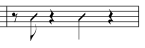
const RhythmicPattern RP45(Beat1And, DurationEighthNote,
  Beat3, DurationQuarterNote);
and
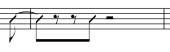
const RhythmicPattern RP48(BeatPickup4And, DurationQuarterNote,
  Beat2And, DurationEighthNote);
After some experimentation, I now think the choice of which rhythmic patterns to play for each chord needs to be made more carefully for the piano part to sound nice. A completely random set of choices sound, well, random! I’ve reverted to much simpler rules in the generation of this accompaniment for Blues for Alice so that the output sounds more acceptable but quite plain. Back to the drawing board for a method to choose rhythmic patterns.
| Sun | Mon | Tue | Wed | Thu | Fri | Sat | |
| 1 | 2 | 3 | 4 | 5 | 6 | • | |
| 7 | 8 | 9 | 10 | 11 | 12 | 13 | • |
| 14 | 15 | 16 | 17 | 18 | 19 | 20 | • |
| 21 | 22 | 23 | 24 | 25 | 26 | 27 | • |
| 28 | 29 | 30 | 31 | ← | |||
| Sun | Mon | Tue | Wed | Thu | Fri | Sat | |
| 1 | 2 | 3 | ← | ||||
| 4 | 5 | 6 | 7 | 8 | 9 | 10 | • |
| 11 | 12 | 13 | 14 | 15 | 16 | 17 | • |
| 18 | 19 | 20 | 21 | 22 | 23 | 24 | • |
| 25 | 26 | 27 | 28 | 29 | 30 | • | |
| Feb May |


Lists
Less-Known Facts About Emacs
Chinese Restaurants in Calgary
Calgary/Banff Tourist Attractions
Top-10 Reason I Stopped Working on Emacs
Misc