MIDI Programs
MIDI File Player (External Device)
MIDI Destination Pop-Up Button
Other Programs
Cocoa Sample Programs
Syntax Coloring Using Flex
Algorithms
Jazz Chord Analysis as Optimization
A blog where I will write mostly about programming in Cocoa and CoreMIDI, and experiences from my ports of Emacs and XEmacs to the Mac OS.
| A Borderless Splash Screen that Fades Out |
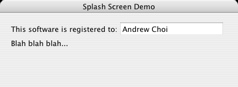
I think a splash screen should be as unintrusive as possible. So I modified yesterday’s splash screen demo to fade out the splash screen panel before it disappears from the screen. The result is a nice “soft” screen effect. The implementation makes use of the Cocoa’s ability to set the alpha value for windows. The rest of it is just programming a timer correctly.
The demo also shows how to use a borderless window (panel actually). This is quite easily achieved by subclassing. The interface builder actually handles NSWindow and NSPanel subclasses correctly by allowing views to be placed into them.
| Nag Screen With Count Down |
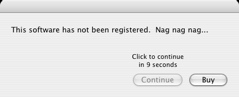
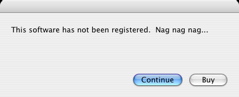
I wrote some code to display a “nag screen”. When an unregistered application is launched, a window is displayed to remind the user to register. It also inconveniences the user a little by enabling the button to dismiss it only after a short delay.
| eSellerate |
I’m back to evaluating e-Commerce service providers. I read eSellerate’s User’s Guide and played around with the ProjectBuilder/Objective-C sample application in their Mac SDK. I was also given a preview account by a very helpful eSellerate account executive (thanks Dan!) so I was able to run through their site’s “Getting Started Wizard” to get an idea of how things are set up using their web interface and go through a few trial (mock) purchases. Here’s a summary of my impression of eSellerate.
- eSellerate is highly recommended by shareware authors on mailing lists (see this search result at the Cocoabuilder archive, for example). People like them for their quick response, technical and customer support, different ways to access the store, ready-made license-key scheme, among other things.
- You can it set up so that the user can buy your application at the time it is installed, from within the application when it’s running, or at a web store. All these are supported by the various parts of the SDK.
- Their SDK and servers are also set up to support “product activation”. This allows the application to challenge the user to authenticate after it has been registered.
- Their SDK and servers also support checks for updated versions which can then be automatically fetched.
- The libraries in their SDK contain routines to support product activation, updates, various ways to buy the application, and of course to validate serial numbers. Understandably the source code isn’t included. Nor is the serial number scheme explained. If one’s main objective is to get products out to market without worrying too much about how copy protection mechanisms should work, and those offered by eSellerate fit one’s requirements, eSellerate is a good way to go.
- Although they can be called from Cocoa, the integrated purchase routines use GUI’s with a Carbon look and feel. These look out of place in a Cocoa application. (Though I’ll only be using the web store.)
- eSellerate’s commission is slightly higher than Kagi’s at certain sales volumes.
| Sun | Mon | Tue | Wed | Thu | Fri | Sat | |
| 1 | 2 | 3 | 4 | 5 | 6 | • | |
| 7 | 8 | 9 | 10 | 11 | 12 | 13 | • |
| 14 | 15 | 16 | 17 | 18 | 19 | 20 | ← |
| 21 | 22 | 23 | 24 | 25 | 26 | 27 | • |
| 28 | 29 | 30 | • | ||||
| Oct Dec |


Lists
Less-Known Facts About Emacs
Chinese Restaurants in Calgary
Calgary/Banff Tourist Attractions
Top-10 Reason I Stopped Working on Emacs
Misc